
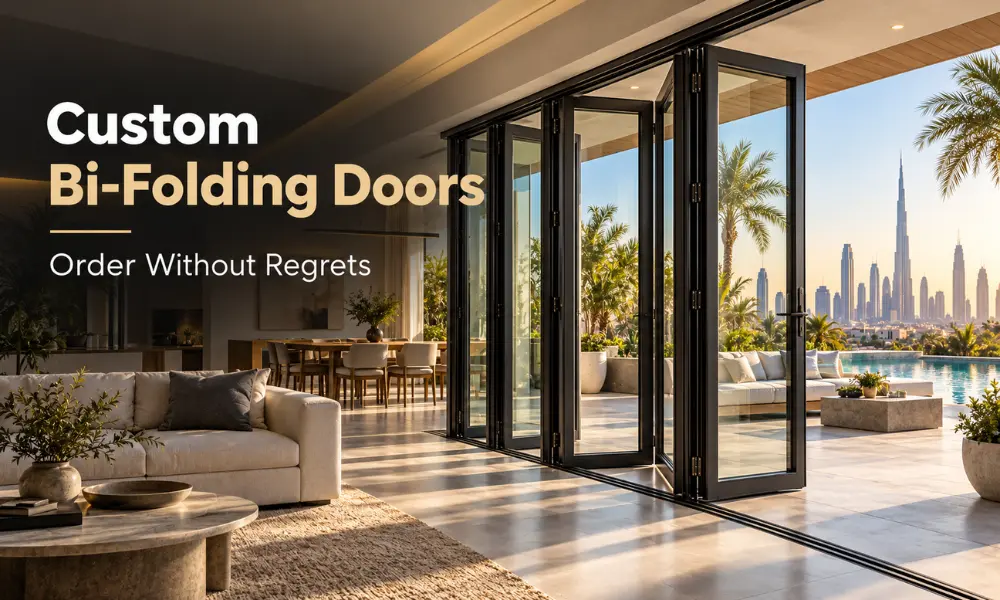
A wall of glass that folds away in seconds sounds simple. Yet most homeowners wait four to six weeks between signing off drawings and seeing their custom bi-folding doors arrive on site. Even then, the real delays rarely come from the factory floor. They start much earlier, at the measuring and decision stage. In a place like Dubai, where summer temperatures regularly pass 45°C, a rushed order with the wrong glass or a badly chosen threshold can turn a dream feature into a daily headache.
Knowing how the ordering process works takes most of the stress out of it. So what actually happens between that first phone call and the moment the panels glide open for the first time?
The First Call and the Site Survey
Every order begins with a chat about the space. Most buyers arrive with a photo, a rough width and a clear idea of the view they want to open up. That helps, but nobody can quote accurately from a phone picture. For that reason, a proper site survey comes next. A surveyor visits the property, measures the opening size at several points, checks whether the floor is level and looks closely at the wall above.
That last part matters more than people expect. If the plan involves knocking through a load-bearing wall, a builder first has to form the aperture and fit a steel lintel to carry the weight above. Since made-to-measure frames are cut to the millimetre, the surveyor should measure the finished opening rather than the old window or wall. A gap of even 10mm can mean extra packers, extra silicone and a door that never quite closes right.
Picking the Panel Configuration
Once the measurements are in, the design conversation starts properly. The panel configuration decides how the doors fold, which side they stack on and how many panels the opening needs. Most panels sit somewhere between 700mm and 1000mm wide, so a 4-metre opening usually works best with four or five panels.
At this point, the lead door becomes an important detail. It works like a normal everyday door, so family members can step into the garden without folding back the whole set. It also carries the multi-point locking system.
Odd-numbered sets make a lead door easy to include, while even-numbered sets need to split left and right to have one. Opening direction comes up too. Outward-opening doors keep the living room free of swinging panels, whereas inward-opening doors suit narrow balconies and tight terraces. Some villa owners realise here that they really want bigger glass with fewer frames, and they switch to aluminium sliding doors instead. That is perfectly fine, and far better than a change of heart after production starts.
Glass, Threshold and Finish Choices
Next comes the spec that affects comfort for years. For UAE homes, double glazing with a Low-E coating keeps a lot of solar heat out. Meanwhile, a thermal break in the aluminium profile stops the frame itself from carrying heat indoors.
Together, these improve the door’s U-value and help keep cooling bills sensible through the summer. Toughened or laminated safety glass is also standard for large panels. The threshold needs a decision as well. A low threshold gives a near-flush step between the lounge and the terrace, while a weathered threshold handles wind-driven rain and dust storms better.
Finally, the buyer picks a RAL colour and the hardware specification. Stock shades like anthracite grey, black and white usually move through production faster than a custom match. Well-built aluminium bi-folding doors also come in dual-colour options, with one shade inside and another outside.
Drawings, Quote and Sign-Off
After all the choices settle, the manufacturer prepares technical drawings and a detailed quote. The drawings show the exact frame size, fold direction, glass build-up and hardware.
Honestly, this is the step most people rush, and it deserves the most attention. A wrong fold direction on paper becomes a wrong fold direction in the house. Typically, the buyer signs the drawings, pays a deposit, and the order officially enters production.
Anyone still at the planning stage can book a free site visit with the FAM Aluminium team and get accurate measurements and drawings sorted before committing to anything.
Manufacturing and Lead Time
Now the factory takes over. Profiles get cut, machined and powder coated, glass units arrive from the glass supplier, and the team assembles and tests each panel. For bespoke systems, the typical lead time is around four to six weeks from signed drawings. Simpler configurations in stock colours can come in closer to three weeks. A factory-direct supplier that handles fabrication in-house usually gives more reliable dates, because nobody waits on a third party to answer a simple question.
A few things tend to stretch the timeline:
- Custom RAL colours or special finishes
- Oversized panels or specialist glass
- Changes to drawings after sign-off
- Orders placed in peak season, just before the cooler months
Installation Day and Handover
When the doors are ready, the installer books a slot and ideally delivers everything on the same day, so the opening stays exposed for as little time as possible. On average, a three-panel set takes three to four hours to fit, and a five or six panel system often needs most of a working day.
The team fixes the frame, hangs and aligns the panels, adjusts the rollers and seals the perimeter. Afterwards, they walk the homeowner through daily operation, the locking system and basic care, such as keeping the bottom track clear of sand. A good installer also hands over warranty details for the frame, glass and coating before leaving.
FAQs
How long does the full ordering process take for custom bi-folding doors?
From the first site survey to installation day, most projects take five to eight weeks. The survey and design stage usually takes one to two weeks, manufacturing takes four to six weeks, and installation itself rarely needs more than a day.
Can bi-folding doors be made for any opening size?
Almost. Since every set is made to measure, manufacturers can fit most standard and wide openings, including corner layouts. Very wide spans may need extra panels or a heavy-duty system, which the surveyor confirms during the site visit.
Is a site survey really necessary before ordering?
Yes. Self-measured orders are the number one cause of poorly fitting doors. A professional survey checks the opening, floor level and wall structure, which protects both the budget and the final finish.
Can the design change after the order is placed?
Small tweaks are usually fine before the drawings are signed. Once production begins, changes become expensive and push the lead time back, so it pays to double-check fold direction, colour and threshold early.
Do aluminium bi-fold doors suit the Dubai climate?
They do. Thermally broken aluminium frames with double glazing handle heat well, while a quality powder coating resists UV fading and humidity. Aluminium also stays stable in extreme temperatures, unlike timber, which can swell and warp.
What affects the price of custom bi-folding doors?
The main factors are overall size, number of panels, glass type, threshold, colour finish and hardware. Larger openings with premium glass and custom colours naturally cost more than standard configurations.