
Wrong measurements create problems that are expensive to fix. In Dubai and across the UAE, custom aluminium windows go straight into production once ordered and manufacturers do not accept returns on custom sizes.
A gap of just 5mm leads to air leaks, rising DEWA cooling bills, and costly reinstallation work. To how to measure aluminium windows correctly, take three separate readings for both width and height using a rigid steel tape measure, then order based on the smallest figure recorded.
Many homeowners and contractors across Dubai assume their opening is perfectly square. In most cases it is not. What follows covers every measurement that actually matters, written specifically for UAE properties, climate conditions, and local building standards.
Why Accurate Measurement Matters in the UAE
Dubai’s extreme heat and dust make precision more critical here than almost anywhere else. Aluminium windows must seal tightly against summer temperatures that regularly exceed 45°C.
A poorly fitted window directly impacts indoor cooling efficiency and pushes up electricity consumption noticeably.
Beyond comfort, Dubai Municipality regulations and UAE Green Building Standards require window installations to meet specific thermal performance and air tightness criteria.
Getting aluminium window sizing right from the start ensures full compliance and prevents expensive rework during handover inspections.
Tools Needed Before Starting
The right tools make window frame measurement reliable from the beginning. A rigid steel tape measure of at least 5 metres is non-negotiable. Cloth and fibreglass tapes expand in UAE heat and introduce errors of 2 to 3mm that silently ruin a custom order.
A spirit level of 600mm or longer confirms horizontal alignment. A carpenter’s square checks corner angles, a notepad records every reading, and a smartphone camera captures each opening with measurements visible for supplier reference. These basics eliminate the most common sources of error before measuring even begins.
Rough Opening vs Retrofit: Know the Difference
This distinction is fundamental to how to measure aluminium windows accurately. A rough opening is a bare structural gap found in new Dubai construction or major renovation work.
The ordered size needs to be 10 to 15mm smaller than the measured opening to allow for levelling and packing.
A retrofit installation involves replacing an existing window inside a finished opening, which is far more common in established Dubai neighbourhoods, older Abu Dhabi apartments, and Sharjah residential buildings.
The clearance here drops to 5 to 10mm. Applying the wrong approach to either situation produces a window that simply does not fit on installation day.
For projects that also involve Aluminium Sliding Doors, the same rule applies. Always confirm the installation type before recording a single measurement.
How to Measure Width and Height Correctly
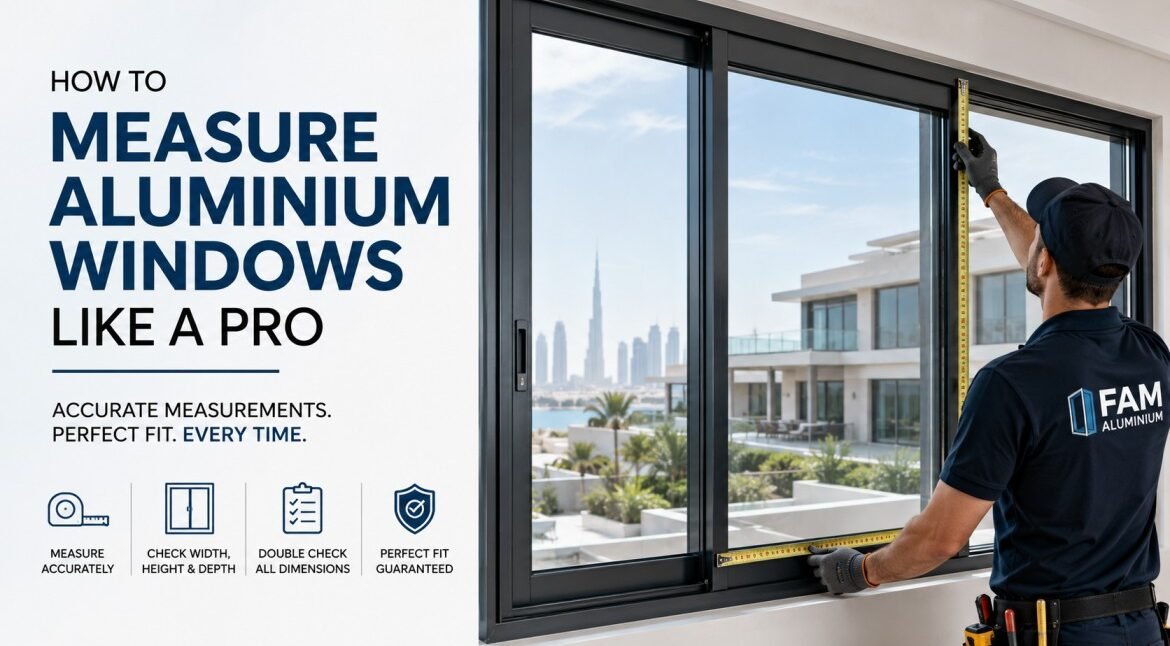
Never rely on a single reading for width or height. Take three width measurements across the opening at the top, middle, and bottom. For height, measure on the left, centre, and right from top down to the sill.
Always order using the smallest figure from each set. For replacement window measurement in Dubai villas or apartments, measure the structural opening rather than the old frame.
Frames warp after years of UAE heat exposure and those inaccuracies carry straight into the new order. One consideration specific to UAE properties is the finished floor level.
Dubai homes commonly use thick marble or large porcelain tiles. That floor height must be subtracted from the height measurement before placing the order.
Check for Square Using Diagonal Measurements
An opening can have correct width and height readings and still cause serious installation problems if it is not square. This step is one of the most valuable in the entire aluminium window fitting process and one of the most frequently skipped on busy UAE construction sites.
Measure diagonally from the top-left corner to the bottom-right corner, then from the top-right corner to the bottom-left corner. A difference under 3mm is perfectly fine.
A gap between 4 and 8mm means on-site packing will resolve it during installation. Anything beyond 8mm requires structural correction or a custom-shaped frame, both of which add cost and delay to any project timeline.
Measuring Sill Depth
Sill depth determines whether the aluminium frame sits flush within the wall or protrudes awkwardly into the interior space.
It is one of the most overlooked steps in the aluminium window sizing process, particularly in UAE villas and high-rise apartments where deep window reveals are common.
Measure from the inside face of the opening to the outer edge of the sill at three points and use the smallest figure. Standard aluminium window frame depth ranges from 50mm to over 90mm depending on the profile selected.
This step is especially important for Sliding Windows where track depth and sliding panel clearance also contribute to the total depth requirement.
Common Mistakes to Avoid
Several errors appear consistently in custom aluminium window orders across UAE projects. Catching them early saves time, money, and serious frustration on site.
- Taking only one measurement per dimension instead of three misses natural variation in the opening
- Measuring the old frame rather than the structural opening carries existing distortions into the new order
- Forgetting to subtract installation clearance produces a window that cannot be levelled on site
- Mixing millimetres and centimetres when recording figures creates conversion errors fabricators may not catch before production
- Skipping the spirit level check leaves horizontal alignment completely unverified and creates visible problems after installation
Recording Measurements and Submitting to a Fabricator
Clear records keep the ordering process smooth and reduce miscommunication with UAE suppliers where production lead times move quickly.
Label each window by its exact location such as “master bedroom south” or “kitchen east” so nothing gets confused in a larger order. Record the three width readings, three height readings, both diagonal measurements, and sill depth for every opening.
Mark the smallest width and height clearly as the ordering dimensions. Before submitting, confirm whether the fabricator wants the raw opening size or the post-clearance figure, as this varies across Dubai suppliers.
For larger UAE projects, contact the team at FAM Aluminium for a professional review before anything goes into production.
FAQs
How many measurements are needed for width and height?
Three readings are needed for each. Always order using the smallest value recorded from each set.
How much clearance should be left when ordering?
Retrofit installations need 5 to 10mm. New build rough openings in UAE construction require 10 to 15mm for packing and levelling.
What if the opening is not square?
Differences under 8mm are manageable with on-site packing. Anything larger needs structural correction or a custom frame discussed with the fabricator before ordering.
Is a cloth tape measure acceptable in Dubai’s climate?
No. Cloth tapes expand in UAE heat and give unreliable readings. A rigid steel tape is the only appropriate tool for this work.
Should the old window or the actual opening be measured?
Always measure the structural opening. Old frames warp in UAE heat cycles and those inaccuracies carry straight into the new order.
Why does sill depth need to be measured?
The sill depth must exceed the chosen aluminium profile’s frame depth. Deep reveals are common in Dubai properties and make this measurement essential before ordering.